
Co-authored by Stephen Zemba, PhD, PE
We’re back with some additional information on toxicity data for per- and polyfluoroalkyl substances (PFAS).
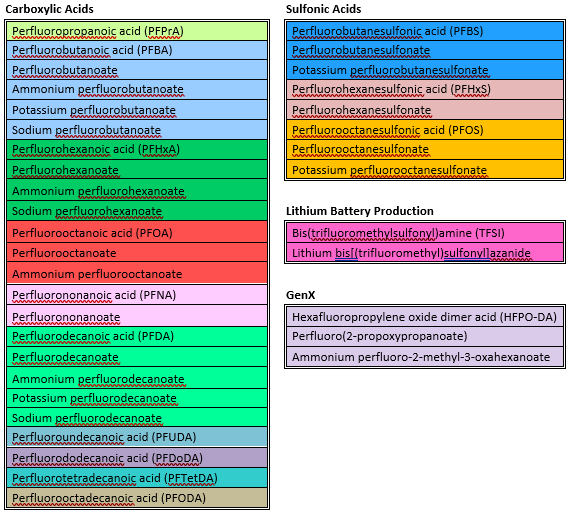
As noted by many, researchers have identified thousands of different PFAS, but toxicity studies have been conducted for only a small number of these compounds. The EPA’s November 2024 Regional Screening Level (RSL) tables include entries for 37 PFAS, but per Table 1, only 15 distinct PFAS are covered, since the RSL list includes chemical synonyms and salt/acid forms of the same compounds.[1] These 15 PFAS account for less than half the 40 analytes included in EPA’s Method 1633A list.[2]
Table 1 – Summary of PFAS Included in the November 2024 EPA RSL Table
______________________
[1] Note that a Method 1633A analysis of PFOA in a groundwater or soil sample will not distinguish among its three RSL forms.
[2] 15 of the 16 distinct PFAS are included on the list of 40 analytes in Method 1633A. The category used in lithium batteries (indicated as TFSI) is not on the standard Method 1633A list.
Despite a general dearth of studies, the EPA accelerated its efforts at developing risk assessment toxicity values from 2022 through early 2025. As indicated in Timeline 1’s depiction of non-cancer reference doses (RfDs), PFBS was first included in the RSL tables in November 2014, and it remained the only listed PFAS until PFOA, PFNA, PFOS, PFHxS, and GenX were added in November 2022.[3] Nine additional compounds were added through the November 2024 update.[4]
Timeline 1 – PFAS Non-Cancer Reference Doses5
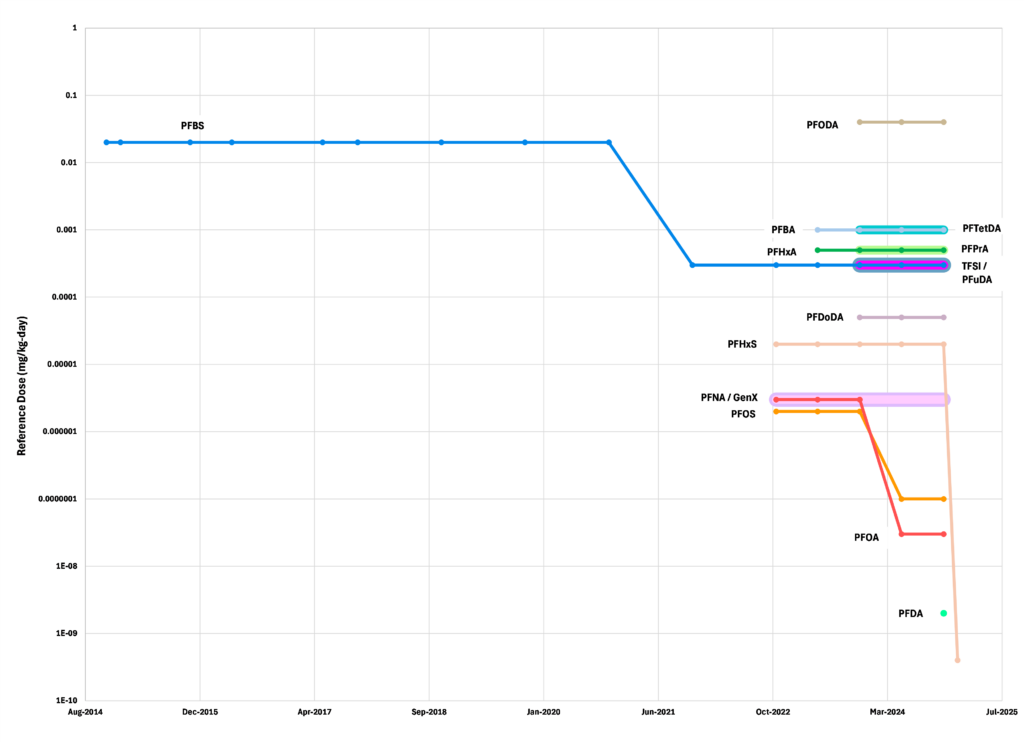
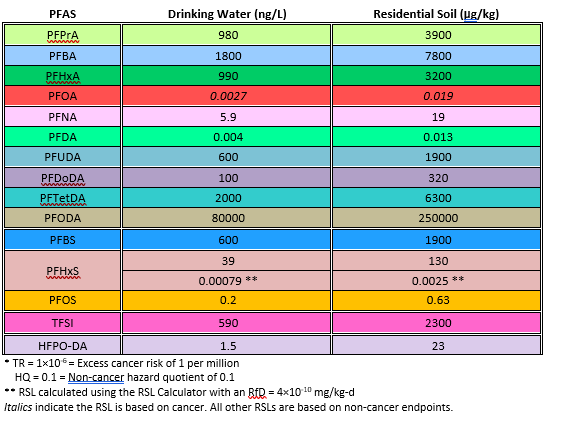
It is noteworthy that RfDs for several PFAS have decreased over time – in some cases by several orders of magnitude – reflecting increasing concerns on the part of the EPA regarding PFAS toxicity. Though not incorporated into the RSLs, the RfD for PFHxS issued in January 2025 is the lowest of all chemicals in the EPA’s Integrated Risk Information System (see a previous blog). The more protective toxicity data are reflected in the EPA’s most recent PFAS RSLs (Table 2), with several values near or below the low ng/L (water) and µg/kg (soil) concentrations that analytical labs are capable of detecting.
______________________
[3] The six PFAS in the November 2022 RSL table update – PFBS, PFOA, PFNA, PFOS, PFHxS, and GenX – were those included in the EPA’s April 2024 promulgation of PFAS drinking water standards, which per a May 2025 announcement will likely be revised.
[4] The November 2024 RSL update is the latest version. Previously, updates typically occurred every six months, hence an update to the RSL tables is overdue.
[5] RSL values from archived copies of the EPA RSL tables were obtained from the EcoIndiana.net website. The January 2025 RfD for PFHxS in Timeline 1 and potency for arsenic in Timeline 2 are taken from the EPA Integrated Risk Information System.
Table 2 – Summary of PFAS RSL Values in the November 2024 EPA RSL Table
(for TR = 1×10⁻⁶ and HQ = 0.1*) 5
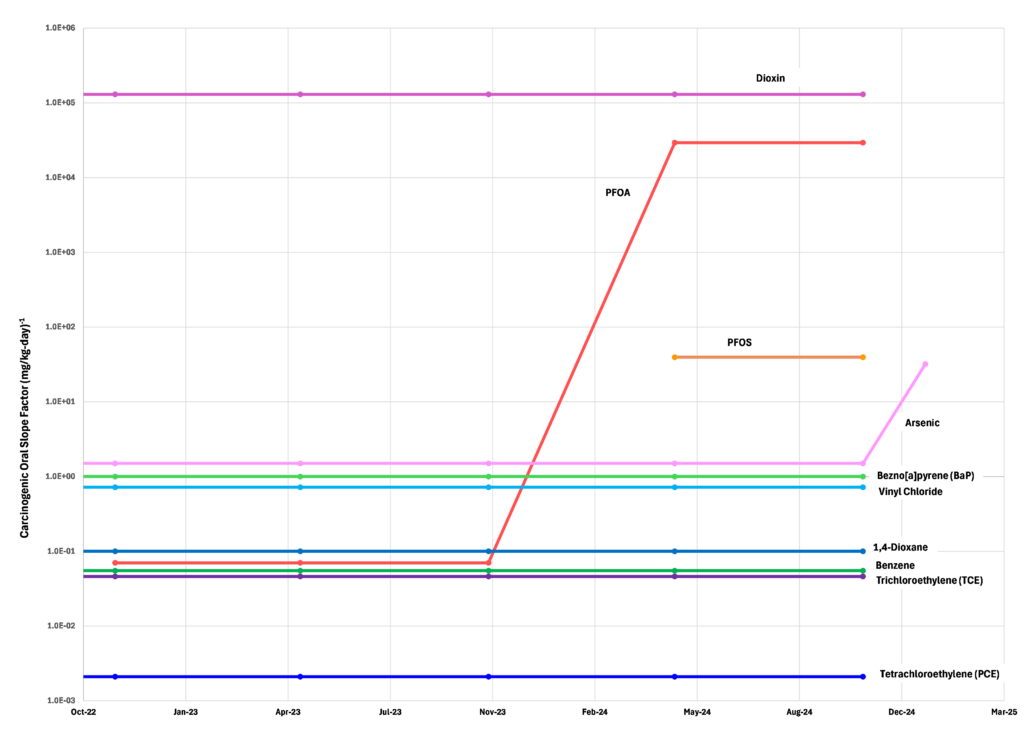
EPA concerns over PFAS carcinogenicity have also emerged in the past few years, and the first cancer potency values appeared in the RSL tables in 2022 (Timeline 2). Even over the short period of time since then, the EPA has increased the cancer potency value for PFOA by more than five orders of magnitude (indicating higher potential cancer risks). A cancer potency value for PFOS was established in May 2024. For perspective, Timeline 2 compares the PFAS cancer potencies of PFOA and PFOS to those of some other chemicals often prominent in risk assessments. As illustrated on Timeline 2, the PFAS cancer potencies values – particularly for PFOA – are significantly higher than those for chemicals considered to be strong carcinogens.
Timeline 2 – Cancer Potency Values for PFAS and Other Chemicals
There have been alternatives proposed to the EPA’s choices/interpretations in establishing PFAS toxicity values, and perhaps adjustments will be made. There was a seeming urgency on the part of the agency to issue values during the Biden era without regard to the traditional consideration of data robustness. The EPA’s stated intent to rescind the scope of the Maximum Contaminant Level drinking water standards for PFAS may be in part related to uncertainties in the toxicity data to support regulatory standards for compounds other than PFOA and PFOS. Also, although toxicity values tend to be revised in the direction of greater protectiveness, there are cases in which toxicity values have been made less protective based on the emergence of new science. For example, the EPA lowered its cancer potency for benzo(a)pyrene (a key polycyclic aromatic hydrocarbon) in 2017. Some careful re-examination may make sense given the cost implications for site cleanups associated with low RSLs, some of which are below detection limits (Table 2). In an era where resource allocations to environmental programs have been slashed, funds for additional PFAS toxicity studies would be beneficial in order to develop robust and practical cleanup standards to protect public health.